Types of Barcodes – Which One Should You Choose for Your Product, Warehouse, or Logistics?
The Complete Guide
Barcodes are one of the cornerstones of modern commerce, manufacturing, and logistics. They allow us to automatically identify products, track batches, manage inventory, handle shipments, and streamline warehouse processes. However, many business owners—especially those of small brands, e-commerce businesses, and manufacturing companies—ask one key question:
“Which barcode should I choose for my application?”
In this guide, we explain the differences between the most important barcodes and suggest which one to choose for a specific situation, product, or process.


What is the difference between 1D and 2D barcodes?
Before choosing a barcode type, it’s important to understand that there are two main categories:
✔ 1D (one-dimensional) barcodes
These are the most common “bar codes” such as EAN, Code 128, and ITF-14. They store a small amount of data (product number, batch number, location).
✔ 2D (two-dimensional) codes
These include DataMatrix and QR codes. They store significantly more information (serial numbers, dates, certificates, links).
The Most Popular Types of Barcodes and Their Uses
Below is a list of the most commonly used barcodes and their practical applications.

EAN codes
EAN-13 – the standard in retail
The most recognizable barcode in the world. If you sell products in brick-and-mortar stores or online, you need an EAN-13.
Applications:
- cosmetics, candles, food, accessories, handmade products,
- products intended for retail chains,
- marketplaces
Advantages:
universal and globally accepted,
readable by all scanners.
EAN-8 – for small products
This is a shortened version of EAN-13. Ideal when there is very little space on the packaging. Applications: small cosmetics, mini packages, small accessories

Logistics codes
Code 128 – logistics, warehousing, manufacturing
This is the most versatile one-dimensional barcode.
Applications:
- logistics and warehouse labels,
- location markings (racks, shelves, containers),
- manufacturing: identification of components, batches, and serial numbers,
shipping documents.
Why is it so popular? Because it can encode letters, numbers, and special characters.
GS1-128 – the standard for logistics data (dates, batches, traceability)
An extension of Code 128 compliant with GS1 standards. It can contain:
- expiration date,
- batch number,
- delivery number,
- quantity,
- pallet or parcel ID.
It is one of the most important codes in industry, pharmaceuticals, logistics, and food production.
ITF-14 – code for master cartons and shipping containers
Typically printed in a large format with thicker lines. Legible even from a greater distance and with low print quality. Applications:
- shipping cartons,
- transport packaging,
- pallets.

Other types of codes
DataMatrix – small components, industrial, medical, and automotive sectors
A two-dimensional code used when a large amount of information needs to be contained within a very small area. Applications:
- electronics,
- machine components,
- medicine (medical devices),
- DPP,
- permanent identification.
- Highly damage-resistant; it can be scanned even after partial damage.
QR – marketing, instructions, documents, links
Although technically not a classic “1D barcode,” it is one of the most commonly used codes on labels. Applications:
- online instructions,
- product sheets,
- videos,
- certificates,
- discounts and landing pages,
- brand storytelling.

Which barcode should you choose for your product or process?
✔ Products sold in stores
→ EAN-13
✔ E-commerce and shipping
→ Code 128 or ITF-14 (for cartons)
✔ Warehouses and logistics
→ Code 128 or GS1-128
✔ Small products or limited space
→ EAN-8 or DataMatrix
✔ Manufacturing and traceability (batch tracking)
→ GS1-128, DataMatrix
✔ Marketing and additional information
→ QR
How to choose the right code for a label?
Selection criteria:
✔ Amount of data
little data → EAN, Code 128
a lot of data → DataMatrix, QR
✔ Surface area
small package → EAN-8, DataMatrix
large box → ITF-14
✔ Usage conditions
harsh conditions → DataMatrix + Avery foil label
warehouse or logistics → high contrast, Code 128
✔ Scanning method
from a distance → ITF-14
up close → EAN, DataMatrix, Code 128

How to print barcode labels so they’re 100% readable?
✔ Choose the right material
paper for products and retail,
film and waterproof materials for logistics, industry, and warehouses,
transparent labels → black barcode required.
✔ Ensure good contrast
The code must be dark on a light background.
✔ Leave a margin
There must be empty space on either side of the code.
✔ High-resolution printing
The more details (e.g., in DataMatrix), the more important print quality becomes.
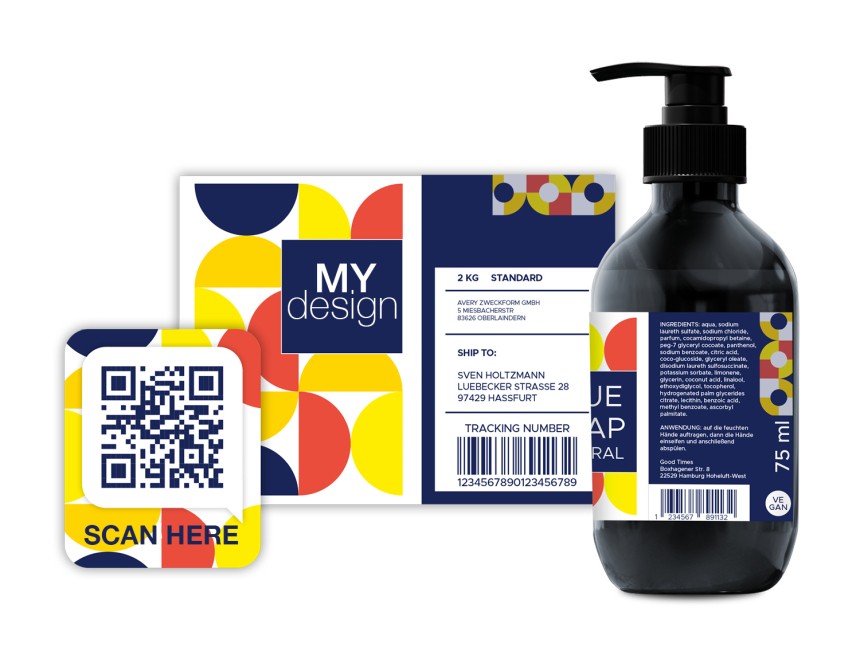
What types of barcode labels does Avery offer?
Avery offers barcode printing on:
- paper labels,
- film labels,
- waterproof labels,
- oil- and abrasion-resistant labels,
- transparent labels,
Ideal for cosmetics, food, e-commerce, logistics, warehousing, and industrial brands.
Choosing the right barcode is key to the proper functioning of the entire system: sales, warehousing, logistics, and tracking.